
Delhi
Delhi, the capital of India, layers Mughal mosques, sultanate towers, old bazaars and the broad avenues of New Delhi into one great city, and it is the natural start of most first trips.
Delhi is a city of many cities. Rulers built and rebuilt their capitals here for centuries, and this travel guide to the things to do in Delhi follows those layers: the towers of the early sultans, the tombs and mosques of the Mughals, the crowded lanes of Old Delhi and the tree-lined avenues of New Delhi, laid out under British rule. It is busy, noisy and generous, and with a good guide it makes sense quickly. For most travellers it is also the gateway to the rest of India.
What to see in Delhi
The sights fall into two halves. Old Delhi, the walled city of the Mughal emperor Shah Jahan, lies in the north. New Delhi and the older tombs and ruins spread south. A day for each is a good way to plan.
Old Delhi, the Red Fort and the Jama Masjid
Shah Jahan built the Red Fort in the seventeenth century as the palace of his new capital, and its massive sandstone walls are a UNESCO World Heritage Site. Inside are marble audience halls and pavilions where the court once met. Nearby, the Jama Masjid is one of the largest mosques in India, with a vast courtyard reached by broad steps. From there, the lanes of Chandni Chowk lead into markets for spices, silver, paper, wedding clothes and sweets. A cycle-rickshaw ride is the easiest way to see them, followed by a walk with your guide to sample street food.
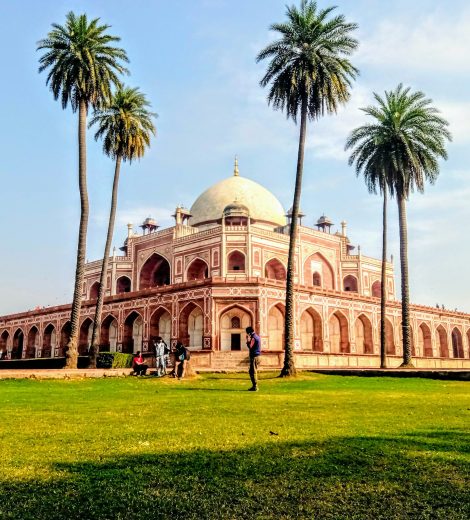
Humayun’s Tomb
Built in the sixteenth century for the second Mughal emperor, Humayun’s Tomb was the first great garden tomb in India, and its design shaped the Taj Mahal that followed. It stands in formal gardens divided by water channels, and it is also a UNESCO World Heritage Site. Visit in the late afternoon, when the red sandstone and white marble glow in the low light. The Sufi shrine of Hazrat Nizamuddin is a short walk away, and the devotional singing held there on some evenings is a moving experience.
Qutb Minar and Mehrauli
In the south of the city, the Qutb Minar is a tall, fluted tower of red and buff sandstone begun in the early thirteenth century, when the Delhi Sultanate was founded. It is surrounded by the remains of early mosques, gateways and an iron pillar far older than the tower itself, and the whole complex is listed by UNESCO. The nearby Mehrauli area has more ruins, step-wells and tombs to explore on foot.
New Delhi
The British built New Delhi as their capital in the early twentieth century. A drive along the ceremonial avenue takes you from the presidential palace, Rashtrapati Bhavan, to India Gate, a war memorial arch. Lodhi Garden, close by, is a green park where the tombs of fifteenth-century rulers stand among lawns used by walkers and families. The National Museum holds a fine collection of Indian art and sculpture if you want a broader picture of the country’s history.
Gurdwaras and temples
Delhi is home to many faiths. At Gurdwara Bangla Sahib, a Sikh place of worship, you can see the community kitchen where volunteers cook and serve free meals to anyone who comes. The Lotus Temple, a Bahá’í house of worship shaped like a lotus flower, welcomes people of all faiths for quiet reflection. Akshardham, a large Hindu temple complex in the east of the city, is known for its intricate stone carving.
Food, markets and the character of the city
Delhi is one of India’s great food cities. You can try kebabs and breads in the lanes around the Jama Masjid, street snacks in Chandni Chowk and dishes from every region of the country in the newer neighbourhoods. For shopping, government craft emporiums sell textiles and handicrafts from across India, and Dilli Haat is an open-air market where artisans from different states sell their work. Delhi’s pace can feel intense at first, but early starts, a driver and a guide who knows the city make it far easier.
Best time to visit Delhi
The best time to visit Delhi is from October to March, when days are warm and dry. Winter evenings can be cold, and fog sometimes affects early travel in December and January. Summer is very hot, and the monsoon brings heavy rain.
| Months | What to expect | Best for |
|---|---|---|
| October to March | Dry, sunny days; cool to cold nights in December and January, with some morning fog | Sightseeing on foot, markets, combining with Agra and Rajasthan |
| April to June | Very hot and dry, with dusty winds | Short visits with early starts and indoor sights in the heat of the day |
| July to September | Monsoon: humid, with heavy showers and greener parks | Flexible city visits and fewer visitors |
How long to stay and how Delhi fits a trip
Two or three nights is ideal. That gives you a day in Old Delhi, a day for the tombs and New Delhi, and time to recover from a long flight. Many travellers also spend a final night here before flying home.
Delhi is the classic start of the Golden Triangle. Agra is about three to four hours by road on the expressway, or about two hours on a fast train. Jaipur is about five hours by road. From Jaipur, you can continue to the tiger country of Ranthambore or further into Rajasthan to Udaipur. Domestic flights from Delhi also reach the holy city of Varanasi in about an hour and a half, and the mountains of Ladakh.
- 1 week: Delhi, Agra and Jaipur, the Golden Triangle at a comfortable pace.
- 10 days: the Golden Triangle plus two nights in Ranthambore or a flight to Varanasi.
- 2 weeks or more: start in Delhi, then travel on through Rajasthan’s forts and lake cities.
Tips for visiting Delhi
- Start early. Monuments are quieter and cooler in the first hours of the day, and the traffic is lighter.
- Dress modestly for religious sites and carry a scarf. Shoes come off at mosques, temples and gurdwaras.
- Some monuments close one day a week. We plan around it, and confirm current ticketing when we book.
- Drink bottled or filtered water, and try street food where your guide recommends it.
Every trip we plan is tailor-made, with your own guide and driver where it helps. Tell us how you like to travel on our plan your trip page, and a specialist will suggest a route.
Highlights
- A cycle-rickshaw ride through the lanes of Chandni Chowk in Old Delhi
- The red sandstone walls of the Red Fort, a UNESCO World Heritage Site
- The courtyard of the Jama Masjid, one of India’s great mosques
- Humayun’s Tomb and its gardens, a forerunner of the Taj Mahal
- The soaring Qutb Minar and the ruins of Delhi’s first sultanates
- A shared meal at the community kitchen of a Sikh gurdwara
- Evening walks in Lodhi Garden among fifteenth-century tombs
- Street food, spice markets and textiles in the old bazaars
When to go & practical information
Best months: October, November, December, January, February, March
Recommended stay: 2–3 nights




Plan your trip to Delhi
Tell us when you would like to go and what draws you to Delhi. We will suggest a route that fits.
Plan My TripFAQs about Delhi
Have more questions? Contact us.
October to March is the most comfortable time, with warm days and cool evenings. December and January can be chilly at night, and morning fog sometimes delays trains and flights. April to June is very hot, and the monsoon brings heavy showers from about July to September.
Two full days covers the highlights: one for Old Delhi and one for New Delhi and the great tombs. With a third day you can explore markets, museums and quieter corners at an easy pace. Many travellers also spend a night here at the end of their trip before flying home.
Yes. Delhi is where most international flights arrive, and the classic Golden Triangle runs from here to Agra and Jaipur before looping back. The drives are easy to break with stops along the way, and fast trains are another option.
Cover your shoulders and knees, and carry a light scarf. You remove your shoes at mosques, temples and gurdwaras, and at gurdwaras everyone covers their head. Photography is not allowed inside some shrines, so ask your guide before you take pictures.
Most visits pass without trouble, and the usual big-city sense applies. Use licensed transport or your own driver, keep valuables out of sight in crowded markets and drink bottled or filtered water. Check your government’s official travel advice before you go.
Not always. Some monuments and museums close one day a week, and ticketing rules change from time to time. We plan your sightseeing around closures and confirm the current arrangements when we book.