
Jaisalmer
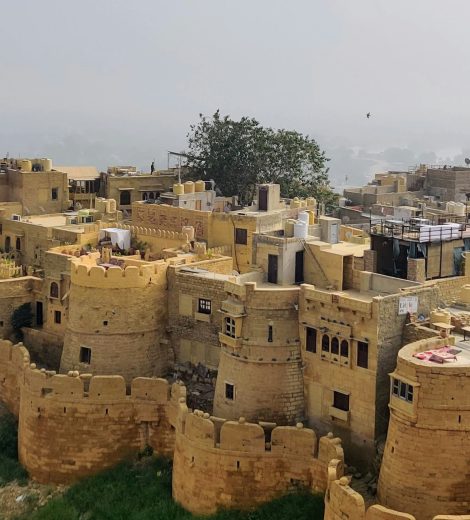
Jaisalmer rises from the Thar Desert in a wall of golden sandstone, with a lived-in fort, carved merchant mansions and sand dunes a short drive away.
Jaisalmer is the westernmost of Rajasthan’s great desert cities, and this travel guide covers the best things to do in Jaisalmer, from the fort to the dunes. Founded in the twelfth century by the Rajput ruler Rawal Jaisal, the city grew rich on the camel caravans that crossed the Thar Desert. Today its yellow sandstone walls, temples and mansions glow gold in the late sun, which is why it is often called the Golden City. It is one of the most rewarding stops on a trip through western India.
What to see in Jaisalmer
The old city is compact and best explored on foot, ideally in the morning before the heat builds. A local guide brings the history to life and helps you find your way through the narrow lanes.
Jaisalmer Fort
The fort sits on a ridge called Trikuta Hill and dominates the skyline. Its double ring of walls and round bastions enclose a small town of houses, shops, temples and guesthouses, and families have lived here for generations. Jaisalmer Fort is one of the six Hill Forts of Rajasthan listed together as a UNESCO World Heritage Site. Walk up through the great gateways to the palace square, then wander the lanes to the ramparts for views across the rooftops to the desert.
The Jain temples
Inside the fort is a group of Jain temples built between roughly the twelfth and sixteenth centuries. Their pillars, ceilings and doorways are carved in remarkable detail from the same yellow stone. Shoes must be removed, leather items are often not allowed inside, and modest dress is expected. Rules on photography and visiting can change, so your guide will explain what applies on the day.
The havelis
Below the fort, wealthy merchant families built tall townhouses called havelis, with facades covered in stone lattice screens and projecting balconies. Patwon ki Haveli is actually a cluster of five houses side by side, and parts of it can be visited. Nathmal ki Haveli and Salim Singh ki Haveli, with its distinctive curved upper floor, are also worth seeking out as you walk through the old quarter.
Gadisar Lake
This man-made reservoir once supplied the city with water. Today it is a peaceful place, lined with small shrines, ghats and a carved stone gateway, and it is lovely early in the morning when the light is soft and local people come to feed the fish and birds.
Bada Bagh and Kuldhara
A short drive north of the city, Bada Bagh is a hillside of royal cenotaphs, or chhatris, built in memory of Jaisalmer’s rulers. It is a classic place to watch the sun set. To the west, the deserted village of Kuldhara is a quiet collection of empty stone houses and lanes, with local stories about why its people left.
The Thar Desert and the dunes
For many travellers, the desert itself is the reason to come. The best-known dunes are at Sam, west of the city, where the sand rises in rolling ridges. Khuri, to the south-west, is usually quieter and has a more village feel. A typical outing combines a drive into the desert with a short camel ride to watch the sunset from the crest of a dune.
You can return to the city for the night or stay at a desert camp. Camps range from simple tents to comfortable ones with proper beds and private bathrooms, and evenings often bring local folk music and dance around a fire, followed by a sky full of stars. The most popular dunes can be crowded at sunset, so we look for calmer places where possible. If you prefer not to ride a camel, a jeep or a walk over the sand works just as well.
Life and culture in the Golden City
Jaisalmer has a strong tradition of folk music, with Manganiyar and Langa musicians singing songs passed down through families. You will also see colourful textiles, mirror-work embroidery, leather goods and carved stone in the markets below the fort. In winter the city usually hosts a desert festival with music, camel events and local competitions; dates follow the lunar calendar, so we confirm them each year.
Best time to visit Jaisalmer
The best time to visit Jaisalmer is from October to March, when days are warm and sunny and nights in the desert can be cold. Summer is fierce, and while the monsoon brings little rain here, the heat and humidity make sightseeing tiring.
| Months | What to expect | Best for |
|---|---|---|
| October to March | Warm, dry days and cool to cold nights, especially in the dunes in December and January | Sightseeing on foot, desert camps, the winter festival |
| April to June | Very hot days and hot, dusty winds | Short early-morning visits only; few travellers come |
| July to September | Hot and humid, with occasional showers | Quieter streets for those who do not mind the heat |
How long to stay and how Jaisalmer fits a trip
Plan on two to three nights. One full day covers the fort, temples, havelis and Gadisar Lake, and a second day leaves time for Bada Bagh, Kuldhara and an afternoon in the dunes. If you would like to sleep at a desert camp, add a night so the trip does not feel rushed.
Jaisalmer is a long way from other cities, so it pays to plan the route carefully. Most travellers arrive by road from Jodhpur, a drive of about five hours across open desert, with chances to stop at villages along the way. Overnight trains connect Jaisalmer with Jodhpur, Jaipur and Delhi, and the small airport has limited flights that change with the season.
A classic Rajasthan route starts in Delhi, continues to Jaipur, then heads west to Jodhpur and Jaisalmer before returning east to Udaipur. Allow about two weeks to do this at a comfortable pace, perhaps adding Agra at the start. We help you decide whether to break the longer drives with a night in a smaller town.
Tips for visiting Jaisalmer
- Start early: explore the fort and havelis in the morning, then rest in the afternoon before heading to the dunes.
- Pack layers: winter nights in the desert are cold, even after a warm day.
- Cover up at temples: wear clothing that covers shoulders and knees, and be ready to remove your shoes.
- Respect residents: the fort is a home as well as a monument, so keep noise down and ask before photographing people.
- Sun and water: bring a hat and sunscreen, and drink bottled or filtered water.
Highlights
- Walking the lanes of Jaisalmer Fort, where people still live and work
- The finely carved Jain temples inside the fort walls
- Stone lattice balconies on the havelis of the old merchant families
- Early morning by Gadisar Lake, with its shrines and pavilions
- Sunset over the royal cenotaphs at Bada Bagh
- A camel ride or jeep drive into the dunes beyond the city
- A night at a desert camp under a wide, starry sky
- The empty stone houses of Kuldhara village
When to go & practical information
Best months: October, November, December, January, February, March
Recommended stay: 2–3 nights
3 journeys in Jaisalmer

Plan your trip to Jaisalmer
Tell us when you would like to go and what draws you to Jaisalmer. We will suggest a route that fits.
Plan My TripFAQs about Jaisalmer
Have more questions? Contact us.
October to March is the most comfortable time, with warm, sunny days and cool or cold nights in the desert. April to June is very hot, and the monsoon brings only a little rain to this dry corner of Rajasthan. Winter is also when the city usually holds its desert festival.
Two to three nights works well. That gives you a day for the fort, temples and havelis, an afternoon and evening in the dunes, and time for Bada Bagh or Kuldhara. If you want to sleep at a desert camp, add a night for it.
Most travellers arrive by road from Jodhpur, a drive of about five hours through the desert. Overnight trains link Jaisalmer with Jodhpur, Jaipur and Delhi. The small airport has limited flights that vary by season, so we check the options when we plan your trip.
For many travellers it is the part of Jaisalmer they remember most. Camps range from simple tents to comfortable ones with private bathrooms, and evenings often include folk music around a fire. The dunes nearest the city can get busy at sunset, so we look for quieter spots where we can.
Yes. Unlike most forts in India, Jaisalmer Fort is still home to families, with houses, shops, temples and guesthouses inside the walls. Please be considerate when you walk through residential lanes and ask before taking photos of people.
Jaisalmer fits naturally into a route through western Rajasthan, usually after Jodhpur. A popular circuit continues from Jodhpur to Udaipur, or starts in Jaipur and heads west. We plan the order to keep long drives manageable.