Paro
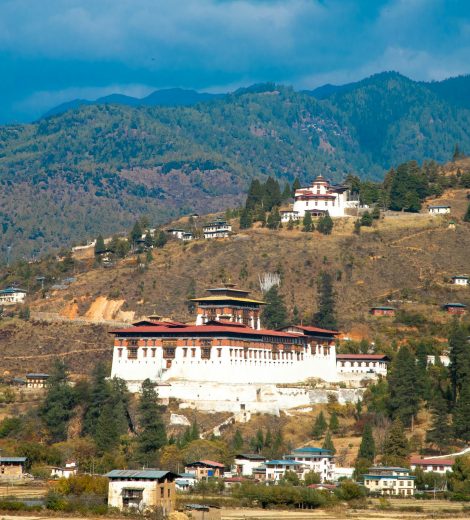
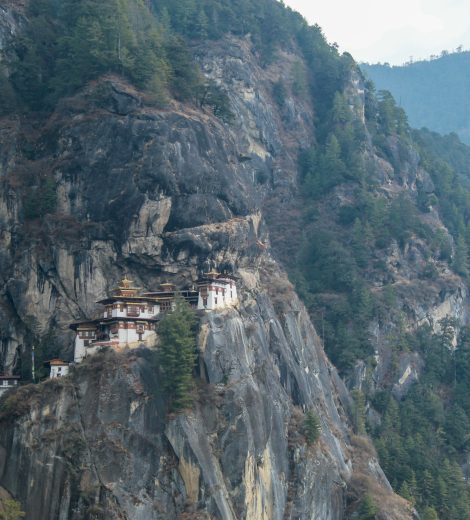
Paro is where most journeys in Bhutan begin: a green valley of rice fields and farmhouses, watched over by a great fortress and the cliff-hanging Tiger’s Nest monastery.
The Paro valley, in western Bhutan, is the first place most visitors see, as it is home to the country’s international airport. There are plenty of things to do in Paro: a hike to the famous Tiger’s Nest monastery, a walk through one of Bhutan’s finest fortresses and visits to some of its oldest temples. The valley sits at around 2,200 metres, with the Paro River running between rice fields, apple orchards and whitewashed farmhouses with painted windows.
Paro town itself is small, with a main street of traditional wooden shopfronts. Most of the valley’s character is found outside it, in the farms, temples and forested hillsides, with high peaks visible to the north on clear days.
Things to do in Paro
Tiger’s Nest (Taktsang)
Taktsang Palphug, known in English as Tiger’s Nest, is the best-known sight in Bhutan. The monastery clings to a sheer cliff high above the valley floor. Legend says that Guru Rinpoche, who brought Buddhism to Bhutan, flew here on the back of a tigress and meditated in a cave on the cliff. The hike up follows a trail through pine forest strung with prayer flags, with a café about halfway that looks across to the monastery. The last section crosses a gorge by steps past a waterfall. Photography is not allowed inside the temples, and your guide will tell you where to leave bags and cameras.
Rinpung Dzong
Rinpung Dzong, a massive fortress-monastery above the Paro River, was built in the 17th century and still houses district offices and a monastic community. Its courtyards, carved wooden galleries and painted walls give a clear sense of how dzongs combine religious and civic life. You reach it on foot across a traditional covered cantilever bridge. In spring, the dzong is the setting for the Paro Tshechu, a festival of masked dances that draws people from across the valley.
National Museum of Bhutan
Above Rinpung Dzong, the old round watchtower known as Ta Dzong houses the National Museum. Its collection covers Bhutanese art, religious paintings, masks, costumes and natural history, and it makes a helpful introduction to the country at the start of your trip. The terrace outside looks down over the dzong and the valley.
Kyichu Lhakhang
Kyichu Lhakhang is one of the oldest and most sacred temples in Bhutan, traditionally said to date back to the 7th century. It is a small, peaceful place where local people come to pray and turn the prayer wheels. Walk around it clockwise, as Bhutanese visitors do.
Drukgyel Dzong and the upper valley
At the head of the valley, Drukgyel Dzong was built to guard the old route to Tibet. It was badly damaged by fire in the 1950s. On clear days, the drive here offers views of the snow peaks to the north. Nearby farmhouses sometimes welcome visitors for tea and a look at traditional family life, which your guide can arrange.
Bhutan’s way of travel
Bhutan has its own approach to tourism, with an emphasis on low-impact travel and respect for its culture and environment. Visits are arranged through licensed tour operators, and visitors generally travel with a licensed guide and driver. Bhutan also charges a daily Sustainable Development Fee. These rules change from time to time, so we confirm the current ones when we book, along with your entry arrangements.
In practice, this makes Paro an easy place to arrive. Your guide meets you at the airport, explains customs as you go, and paces each day around you.
Best time to visit Paro
The best time to visit Paro is in spring and autumn, when the days are mild and the skies are usually clear. Each season has its own character.
| Months | What to expect | Best for |
|---|---|---|
| March to May | Mild days, flowering trees and rhododendrons on the hills; the Paro Tshechu festival | Festivals, the Tiger’s Nest hike and valley walks |
| June to August | Monsoon rain and cloud, lush green fields; trails can be slippery | Quiet visits for flexible travellers |
| September to February | Clear skies and harvest colours in autumn; cold, dry and often sunny in winter | Mountain views, hiking and photography |
How long to stay and how Paro fits a Bhutan trip
Two or three nights in Paro is ideal. Many travellers spend a night here on arrival, drive on to other valleys, then return to Paro at the end of the trip to hike to Tiger’s Nest once they are used to the altitude, before flying out.
The capital, Thimphu, is about an hour’s drive away. From Thimphu, the road continues over the Dochula pass to Punakha, about three hours further, in a warmer, lower valley. A first trip of about a week often follows this loop: Paro, Thimphu, Punakha and back to Paro. With more time, you can add quieter valleys to the east.
Flights to Paro connect with cities including Delhi and Kathmandu, so Bhutan pairs naturally with a trip through India or Nepal.
Tips for visiting Paro
- Save the big hike: do Tiger’s Nest near the end of your trip, after a few days at altitude.
- Start early: morning starts are cooler and quieter on the trail.
- Dress respectfully: long sleeves and covered knees for dzongs and temples.
- Ask about photography: it is not allowed inside many temple rooms.
- Walk clockwise: around temples, stupas and prayer wheels.
To start planning, share your dates and interests on our plan your trip page, and a specialist will design a tailor-made journey through Bhutan, with your own guide and driver.
Highlights
- Hiking up to Tiger’s Nest (Taktsang), clinging to a sheer cliff
- Exploring the courtyards of Rinpung Dzong above the Paro River
- Crossing the traditional covered bridge below the dzong
- Learning about Bhutan’s history at the National Museum
- Kyichu Lhakhang, one of the oldest temples in Bhutan
- Drukgyel Dzong, the old fortress guarding the head of the valley
- The Paro Tshechu festival with masked dances in spring
- Farmhouse visits and walks among the valley’s rice fields
When to go & practical information
Best months: March, April, May, September, October, November
Recommended stay: 2–3 nights


Plan your trip to Paro
Tell us when you would like to go and what draws you to Paro. We will suggest a route that fits.
Plan My TripFAQs about Paro
Have more questions? Contact us.
Spring, from March to May, and autumn, from September to November, bring the most pleasant weather and good mountain views. Spring is also the season of the Paro Tshechu festival, with dates set by the lunar calendar. Winter is cold but often clear, while the summer monsoon brings rain and cloud.
Two or three nights works well. That gives you a full day for the Tiger’s Nest hike and time for Rinpung Dzong, the National Museum and Kyichu Lhakhang. Many travellers spend one night in Paro on arrival and save the hike for the end of their trip, once they are used to the altitude.
It is a steady climb on a well-used trail, and most reasonably fit walkers manage it at their own pace. Allow about five hours or more for the round trip, including time at the monastery. There is a café about halfway up with views of the monastery, which makes a good resting point.
Paro has Bhutan’s main international airport, with flights from cities including Delhi and Kathmandu. The approach is through a narrow mountain valley, and flights can be affected by weather. Visits to Bhutan are arranged through licensed tour operators, and we organise your flights, guide and transport as part of your trip.
Travel in Bhutan is arranged through licensed operators, and visitors generally travel with a licensed Bhutanese guide. Bhutan also charges a daily Sustainable Development Fee. These rules change from time to time, so we confirm the current arrangements when we book.
Cover your shoulders and knees, and choose long sleeves and long trousers or skirts. Remove your hat inside courtyards and your shoes before entering temple rooms. Photography is not allowed inside many temple rooms, so check with your guide first.