Colombo
Sri Lanka’s commercial capital mixes colonial streets, crowded markets, Buddhist temples and an ocean promenade, and it is where most trips to the island begin or end.
Colombo is the largest city in Sri Lanka and its commercial heart, a working port on the west coast where colonial buildings stand beside glass towers. If you are looking for things to do in Colombo, this guide covers the old Fort district, the market lanes of Pettah, the sea promenade of Galle Face Green and the city’s best-known temples. Most travellers spend a night or two here at the start or end of a trip, and a day is enough to get a feel for the place.
What to see and do in Colombo
The main sights sit within a short drive of each other, along the coast and around Beira Lake. A half-day walk or a tuk-tuk ride with a local guide covers the centre comfortably, and the traffic is easier early in the day.
Fort and its colonial buildings
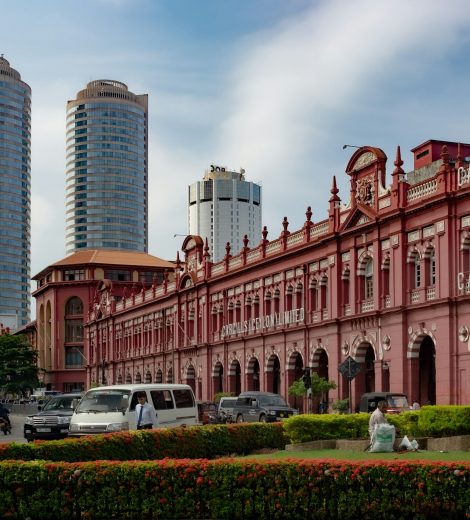
Fort was the heart of the city under the Portuguese, the Dutch and the British, and it is still a district of banks, offices and government buildings. Look out for the old Parliament building facing the sea, the clock tower that once served as a lighthouse, and the Old Dutch Hospital, a restored colonial building with shaded courtyards. Many grand façades have been cleaned up in recent years, and the area is pleasant to explore on foot.
Pettah and its markets
Just east of Fort, Pettah is Colombo at its most crowded and lively. Each street tends to specialise, with lanes for spices, fabrics, hardware, fruit or electronics, and handcarts squeezing between the stalls. The red-and-white Jami Ul-Alfar Mosque is one of the city’s most photographed buildings, and the small Dutch Period Museum, in an old colonial house, tells the story of the Dutch era. Go in the morning, keep your bag in front of you and let your guide lead you through the busiest lanes.
Galle Face Green
This long, grassy promenade runs beside the Indian Ocean south of Fort. In the late afternoon it fills with families, kite-flyers, couples and food stalls selling spicy fritters and grilled corn. It is one of the best places in the city to watch the sunset and see Colombo relaxing.
Gangaramaya Temple and Seema Malaka
Gangaramaya is one of Colombo’s best-known Buddhist temples, an eclectic complex of shrines, a library and a museum filled with gifts from devotees, from statues to vintage cars. Close by, Seema Malaka is a simple, calm temple on platforms in Beira Lake, designed by the Sri Lankan architect Geoffrey Bawa. Cover your shoulders and knees and remove your shoes at both.
National Museum and Cinnamon Gardens
The National Museum, in a white colonial building in the leafy Cinnamon Gardens district, holds royal regalia, Buddhist and Hindu sculpture and objects from the ancient capitals. It is a useful introduction before you travel to the Cultural Triangle. Nearby, Viharamahadevi Park and the Independence Memorial Hall make a quiet stop away from the traffic.
Food and city life
Colombo is a good place to start eating your way around the island. Try hoppers, bowl-shaped pancakes made from rice flour and coconut milk, often with an egg cooked in the middle. Kottu, chopped flatbread stir-fried with vegetables, egg or meat, is cooked on hot griddles with a rhythmic clatter you will hear from down the street. A proper rice and curry lunch brings several small dishes of vegetables, lentils and sambol around a mound of rice.
The city also reflects the island’s mix of faiths: Buddhist temples, Hindu kovils, mosques and churches often stand within a few streets of each other. Shopping is easy too, from tea and spices to handloom textiles and contemporary design. Ask your guide to take you to a tea shop where you can taste a few grades before you buy.
Best time to visit Colombo
Colombo is hot and humid all year, and the sea breeze helps in the evenings. Sri Lanka has two main monsoons that affect different coasts at different times. The southwest monsoon, roughly from May to September, brings rain to the west and south coasts, including Colombo. The northeast monsoon, roughly from November to February, mainly affects the east and north. Between them, October and November can bring heavy showers across much of the island. In practice, rain in Colombo often comes as short, heavy bursts, so the city works in any month.
| Months | What to expect | Best for |
|---|---|---|
| December to March | Drier, sunny and hot, with lower humidity than mid-year | City walks, sunsets on Galle Face Green, combining with the south coast |
| April to September | Hotter in April, then the southwest monsoon brings regular rain and cloud | Museums, temples and food; heading to the east coast for beaches |
| October and November | Changeable, with heavy showers possible across the island | Short city stays between other parts of the trip |
How long to stay and how it fits a trip
One full day covers the main sights, so most people stay one or two nights. Colombo works well as a first night to recover from a long flight, or as a last night before your flight home. If your flight lands late or leaves early, a hotel near the airport or in the beach town of Negombo can save time in traffic.
From Colombo, the road and rail routes fan out across the island. The expressway reaches Galle on the south coast in about two hours, and the coastal railway line is a slower, scenic alternative. Inland, Kandy is about three to four hours by road, or a little less by train. Sigiriya and the Cultural Triangle are about four to five hours north-east by road.
A classic first trip of about two weeks might start in Colombo, head north to Sigiriya, continue to Kandy, take the hill-country train to Ella and finish on the south coast near Galle. It is also a short flight from Colombo to Malé if you want to add a few days in the Maldives at the end.
Tips for visiting Colombo
- Go early: traffic builds through the day, so plan sightseeing for the morning and save Galle Face Green for the evening.
- Dress for temples: cover your shoulders and knees, and carry socks if you mind hot paving stones when barefoot.
- Use metered or booked transport: a private driver or an app-based ride is easier than flagging down vehicles on the street.
- Stay hydrated: the humidity is tiring, so carry water and take a break in the hottest hours.
If you would like help shaping a route around Colombo and the rest of the island, tell us your dates and interests on our plan your trip page.
Highlights
- A walk through the colonial streets and restored buildings of Fort
- The crowded market lanes and red-and-white mosque of Pettah
- Sunset snacks among local families on Galle Face Green
- Gangaramaya Temple and its eclectic collection of offerings
- The small lake temple of Seema Malaka on Beira Lake
- Sri Lankan history at the National Museum
- Hoppers, kottu and rice and curry from the island’s many kitchens
- An easy first or last night close to the international airport
When to go & practical information
Best months: December, January, February, March
Recommended stay: 1–2 nights, often at the start or end of a trip


Plan your trip to Colombo
Tell us when you would like to go and what draws you to Colombo. We will suggest a route that fits.
Plan My TripFAQs about Colombo
Have more questions? Contact us.
Start with a walk through Fort and the markets of Pettah, then visit Gangaramaya Temple and Seema Malaka on Beira Lake. In the evening, head to Galle Face Green for the sunset and street snacks. If you have more time, add the National Museum and a slow lunch of rice and curry.
Colombo is hot and humid all year. The driest months are usually December to March. The southwest monsoon brings heavier rain from roughly May to September, and October and November can see sudden downpours, but showers often pass quickly and the city is easy to visit in any month.
One full day is enough for the main sights, so most travellers spend one or two nights at the start or end of a trip. If you land late or leave early, a night near the airport or in Negombo can be more practical than staying in the city.
The international airport is at Katunayake, north of the city. By road it usually takes about an hour to reach central Colombo on the expressway, though traffic can make it longer. We arrange your private transfer as part of the trip.
Yes, for a day or so. It gives you a feel for modern Sri Lanka, its trading history and its mix of faiths and food before you head inland. Travellers who prefer to go straight to the beach or the hills can skip it and stay near the airport instead.
Cover your shoulders and knees, and take off your shoes and hat before entering a temple. Light, loose clothes are best in the heat. Avoid posing for photos with your back to a Buddha statue, which many people consider disrespectful.