Annapurna Base Camp Trek


Overview
- Duration: 14 days / 13 nights
- Departures: Private, any date
- Group size: Private, from 1 traveller
- Accommodation: Comfortable 3–4★ hotels in Kathmandu and Pokhara and simple family-run teahouses on the trek
- Country: Nepal
Trek from the lake town of Pokhara through terraced villages and bamboo forest into the Annapurna Sanctuary, a high basin of ice and rock in the heart of Nepal, sleeping in family-run teahouses.
This trek suits fit walkers who want a full Himalayan journey that reaches a real high-mountain landscape without the remoteness of the far east of Nepal. It works for couples, friends and confident solo trekkers, and it fits well into a two-week holiday.
After two nights in Kathmandu and a night in Pokhara, you walk for nine days. The first part crosses farmland and Gurung villages such as Ghandruk and Chhomrong, linked by stone staircases. The trail then enters the narrow Modi Khola gorge, through bamboo and rhododendron forest, before opening into the Annapurna Sanctuary, a glacier basin almost completely surrounded by peaks. The descent passes the hot springs at Jhinu Danda, and a buffer day at the end absorbs any delay.
You stay in simple teahouses, where meals are usually included, with a licensed guide and a porter. Pace is steady rather than fast. A few honest notes:
- Altitude: you sleep at around 4,130 metres at Base Camp. The plan includes a short day and an extra night lower down first.
- Steps: thousands of stone steps make the trek tiring on knees, so walking poles help.
- Season: in late winter and early spring, parts of the gorge can carry an avalanche risk, and your guide may change the timing or route.
We can adapt the route, for example adding the Poon Hill sunrise viewpoint on the way in, a slower descent, or extra days in Pokhara or Chitwan. Tell us your dates and experience and we will plan around you.
Day-by-day itinerary
You are met at Kathmandu airport and driven to your hotel. Take the rest of the day to recover from the journey. In the evening your trekking guide stops by to introduce themselves, run through the route, and look over your boots, jacket and sleeping bag, so there is time to fill any gaps in your kit before you leave the city.
Overnight: Kathmandu
A gentle day of sightseeing with a local guide helps you adjust to the time change. Visit Swayambhunath on its hilltop, walk among the temples of Kathmandu Durbar Square, and finish at Boudhanath, where Tibetan families circle the great white dome at dusk. Pick up any last snacks or gear in Thamel and pack a small bag to leave at your hotel.
Overnight: Kathmandu · Meals: Breakfast
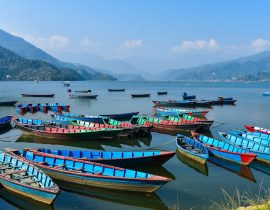
Take a short flight west to Pokhara, or travel about six to seven hours by road through river valleys and terraced hills. Pokhara lies beside Phewa Lake, and on clear days the fishtail summit of Machhapuchhre rises straight above the town. Spend the afternoon by the water, perhaps rowing out to the small island temple, and get an early night.
Overnight: Pokhara · Meals: Breakfast
Drive about two hours into the foothills to the start of the trail, then walk up stone steps between rice and millet terraces to Ghandruk, a large Gurung village at around 1,950 metres. Slate-roofed houses line its paved lanes, and a small museum shows traditional Gurung life. Annapurna South and Machhapuchhre stand at the head of the valley in the late light.
Overnight: Ghandruk · Meals: Breakfast, Lunch, Dinner
Climb over a forested ridge, then descend to cross the Kimrong Khola before another long ascent. The trail is a mix of steps, mud paths and stretches through oak and rhododendron woods. By afternoon you reach Chhomrong, at around 2,170 metres, the last permanent village on the route, its lodges stacked down the hillside facing Annapurna South.
Overnight: Chhomrong · Meals: Breakfast, Lunch, Dinner
Descend the long stone stairway from Chhomrong to the river, then climb again before the trail enters the Modi Khola gorge. The walls narrow and the forest thickens with bamboo, rhododendron and oak, with streams and small waterfalls along the way. Overnight at Dovan, a small cluster of lodges in the woods at around 2,500 metres.
Overnight: Dovan · Meals: Breakfast, Lunch, Dinner
The valley grows wilder as you climb out of the forest, past a rock shrine sacred to local people where guides ask trekkers to pass quietly. Above the bamboo, the vegetation thins to grass and shrubs. Deurali, at around 3,200 metres, sits beneath steep cliffs; in early spring, your guide may choose the safest line here if there is any risk of avalanche.
Overnight: Deurali · Meals: Breakfast, Lunch, Dinner
A deliberately short walk of about two to three hours takes you up to Machhapuchhre Base Camp, at around 3,700 metres, where the gorge opens into the Sanctuary. The extra night here helps your body adjust before going higher. Rest in the afternoon, take a slow stroll above the lodges, and watch the evening light move across the mountain’s twin summit.
Overnight: Machhapuchhre base camp · Meals: Breakfast, Lunch, Dinner
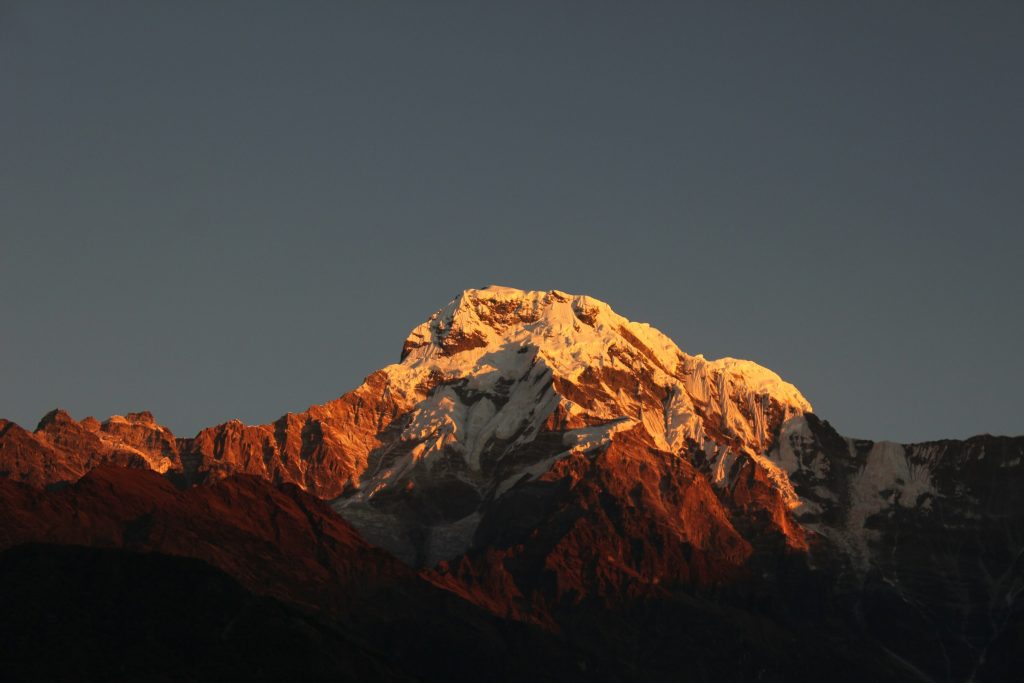
Walk up the open valley beside the moraine for about two hours to Annapurna Base Camp, at around 4,130 metres. Annapurna I, Annapurna South, Hiunchuli and Machhapuchhre form a near-complete ring of peaks around you. Spend the day exploring the viewpoints along the glacier edge, and wrap up well: nights here are well below freezing, even in the main seasons.
Overnight: Annapurna base camp · Meals: Breakfast, Lunch, Dinner
Rise before dawn to watch the summits glow first pink, then gold, while the basin is still in shadow. After breakfast, begin the long descent, retracing your steps past Deurali and back into the forest. Losing height quickly brings warmer air and easier breathing. Overnight at Bamboo, a cluster of lodges named after the forest around it.
Overnight: Bamboo · Meals: Breakfast, Lunch, Dinner
Climb back up to Chhomrong, which feels harder on tired legs, then drop steeply down to Jhinu Danda, at around 1,780 metres. About twenty minutes below the village, natural hot springs sit beside the river, and a soak there is a good reward after days in the cold. The evening is warm enough to sit outside the lodge.
Overnight: Jhinu Danda · Meals: Breakfast, Lunch, Dinner
A shorter walk follows the river and farmland down to the road head, where your driver waits for the drive of about two to three hours back to Pokhara. Check into your hotel, have a long hot shower and send your laundry out. In the evening, stroll the lakeside, try a few cafés, and toast the trek with your guide and porter.
Overnight: Pokhara · Meals: Breakfast, Lunch
Return to Kathmandu by a short flight, or about six to seven hours by road. This day also works as a buffer if bad weather or a slow day held you up on the trail. If you arrive early, visit Patan’s Durbar Square or browse the craft shops near your hotel, and enjoy a farewell Nepali dinner.
Overnight: Kathmandu · Meals: Breakfast
After breakfast, your driver takes you to the airport for your onward flight. If you would like more time in Nepal, a few days on safari in the lowlands or a night in the hill town of Bhaktapur make a gentle end to the journey. End of your trip.
Overnight: — · Meals: Breakfast
What’s included
- Hotel accommodation in Kathmandu and Pokhara with breakfast
- Teahouse lodges on the trek, usually with breakfast, lunch and dinner
- Private airport and hotel transfers, and road transfers to and from the trailhead
- Short flights or private road transfers between Kathmandu and Pokhara
- Licensed English-speaking trekking guide and a porter
- Annapurna Conservation Area trekking permits (we arrange them; confirmed in your quote)
- Local guide and entrance fees for sightseeing in Kathmandu
- 24/7 support during your trip
Not included
- International flights
- Visas
- Travel insurance that covers trekking at altitude and helicopter evacuation
- Lunches and dinners in Kathmandu and Pokhara, except where listed
- Drinks, hot showers, device charging and wifi in the lodges
- Tips for your guide and porter
- Personal trekking gear
Good to know
Sample itinerary: we adapt the route, hotels and dates to you and confirm everything in your written quote. Best October–November and March–May.
Kathmandu and Pokhara are linked by a short flight or about six to seven hours by road, and the trailhead is about two hours from Pokhara by private vehicle. On the trek you walk most days for about five to seven hours, on a trail with many stone steps, while a porter carries your main bag. Road conditions in the hills vary, especially after the monsoon.
Frequently asked questions
It is a moderate to challenging trek with no technical climbing. The hardest part is the many stone staircases, especially around Chhomrong, rather than the distances. You should be used to walking five to seven hours a day on steep ground.
Annapurna Base Camp sits at around 4,130 metres. The route climbs gradually, with a short day and an extra night at Machhapuchhre Base Camp before the top. Altitude affects people differently, so see a doctor before you travel and take out insurance that covers trekking at altitude and evacuation.
Yes, breakfast, lunch and dinner are usually included while you are on the trail, eaten in the teahouses. Expect hearty food such as dal bhat, noodles, soups and eggs. Menus get simpler higher up, because supplies are carried in on foot.
Yes, trekkers need permits for the Annapurna Conservation Area. Rules for permits and guides in Nepal change from time to time, so we confirm the current requirements and arrange the paperwork when we book.
Yes, and many travellers do. An extra day or two in Pokhara lets you rest by the lake, take a sunrise trip to Sarangkot for mountain views, or try paragliding. We can also add a few nights in Chitwan for a lowland contrast.